
MCAS or Histamine Intolerance? How to Tell the Difference
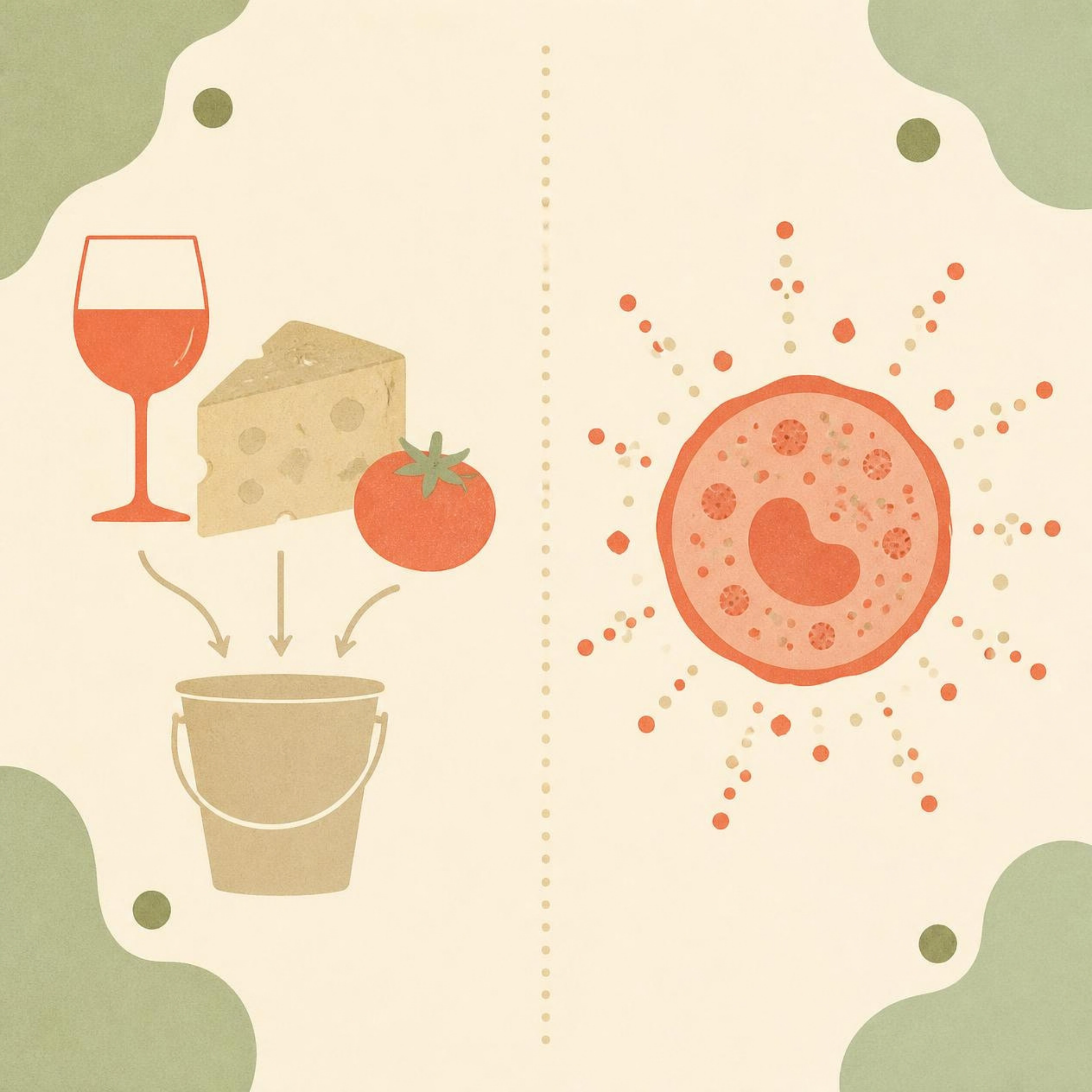
If you have been searching for an explanation for why you react to wine, aged cheese, leftovers and half a dozen other things, you will have come across both terms. They get used interchangeably online, and they should not be. The symptoms overlap considerably, but the underlying problem is different, and so is what tends to work.
Here is the distinction, without the jargon.
Histamine intolerance: too much coming in
Histamine intolerance is essentially a capacity problem.
Histamine occurs naturally in food, particularly anything aged, fermented, cured or left in the fridge for a few days. Your body breaks it down using enzymes, mainly diamine oxidase in the gut wall. If those enzymes are not keeping up with what is arriving, histamine accumulates and you get symptoms.
The key point is that the histamine is largely coming from outside you. Your own cells are not misbehaving - the clearance system is simply overwhelmed, or under-performing, relative to the load.
That is why histamine intolerance tends to be fairly food-driven and reasonably predictable. Reactions follow eating. Particular foods are reliably problematic. And reducing the dietary load usually produces a noticeable improvement within days to a couple of weeks.
I have written in more detail about histamine intolerance and how it is managed.
MCAS: too much being released
Mast cell activation syndrome is a different mechanism.
Mast cells are immune cells found throughout your body, in skin, gut, airways and around blood vessels. Their job is to release histamine and a range of other mediators when they detect a genuine threat. In MCAS, they release those mediators inappropriately, in response to things that should not warrant it.
So the problem is not clearance capacity. It is that the cells themselves are over-reactive, and histamine is only one of many substances they release; tryptase, prostaglandins and leukotrienes are involved too.
This is why MCAS tends to look broader and less predictable. Triggers often extend well beyond food to heat, cold, exercise, stress, scents, medications, alcohol and friction on the skin.
There is also a second category worth understanding: the things that appear to set the whole picture off in the first place. Many people can date the onset of their symptoms to a specific event, a viral infection, or a period living or working in a water-damaged, mouldy building. Mould exposure and viral illness are among the more commonly reported precipitants, and they differ from the triggers above in that they are not simply causing a reaction in the moment. They appear to shift mast cell behaviour more persistently.
If your symptoms started after a virus and you are also dealing with fatigue that has not lifted, post-viral fatigue may be part of the same picture.
This matters practically, because if you are still living in the building, removing foods from your diet is unlikely to achieve much.
The practical differences
| Histamine intolerance | MCAS | |
|---|---|---|
| Underlying problem | Clearance cannot keep up with intake | Mast cells release mediators inappropriately |
| Main source | Histamine in food | Your own immune cells |
| Typical triggers | Foods, mostly | Foods, heat, stress, scents, exercise, medications; often set off by mould exposure or viral illness |
| Pattern | Fairly predictable, follows eating | Less predictable, often multi-system |
| Response to a low-histamine diet | Usually helpful, often substantially | Partial at best - it is one input among many |
That last row is the most useful line in this article. If you have done a genuine low-histamine trial with a clinician and improved considerably, histamine intolerance is the more likely explanation. If you improved a little but are still reacting to things that have nothing to do with food, the diet was never going to be sufficient on its own.
Why it matters which one you have
Because the approaches diverge.
Histamine intolerance responds to reducing the load and, importantly, to addressing why clearance is struggling in the first place. Gut inflammation, certain medications and an imbalanced microbiome can all affect diamine oxidase activity, and gut repair often does more for it in the long run than a permanent low-histamine diet.
MCAS is a medical diagnosis and needs medical management. There are diagnostic criteria, and there is a medication-based approach that a doctor oversees. Nutrition has a supporting role, in reducing unnecessary triggers, working on gut health and being realistic about what diet can and cannot do, but it is not the primary treatment.
There is also a third possibility worth naming: neither. Symptoms of this kind can come from small intestinal bacterial overgrowth, from gut dysbiosis after infection or antibiotics, or from other causes entirely. I have written about why widespread reactivity develops, and the honest answer is that it is often not the diagnosis people have arrived at from reading online.
Where to start
If food is clearly the pattern, a structured low-histamine trial with support is a reasonable first step. It should be a trial, with a defined end point, not a permanent way of eating.
If your triggers extend well beyond food, or you are having reactions that frighten you, that is a conversation for your doctor before anything else.
It is also worth thinking back to when this started. If your symptoms began after a viral illness, or after moving into a particular home or workplace, that is significant information and worth raising with your doctor. Ongoing exposure to a water-damaged building is not something diet can work around.
And if you have already restricted your diet substantially and things are still getting narrower, that is worth taking seriously as a sign in itself. It usually means the underlying driver has not been identified yet.
Working with me
I am a clinical nutritionist in Sydney and I work as part of an integrative medical team, which means the medical side of this can be addressed alongside the nutritional side rather than separately. Consultations are available in person and by telehealth.
This article is general information and not a substitute for individual medical advice. MCAS is a medical diagnosis requiring assessment by a doctor.