
You Were Born With Almost No Gut Bacteria. So Where Did 38 Trillion Come From?
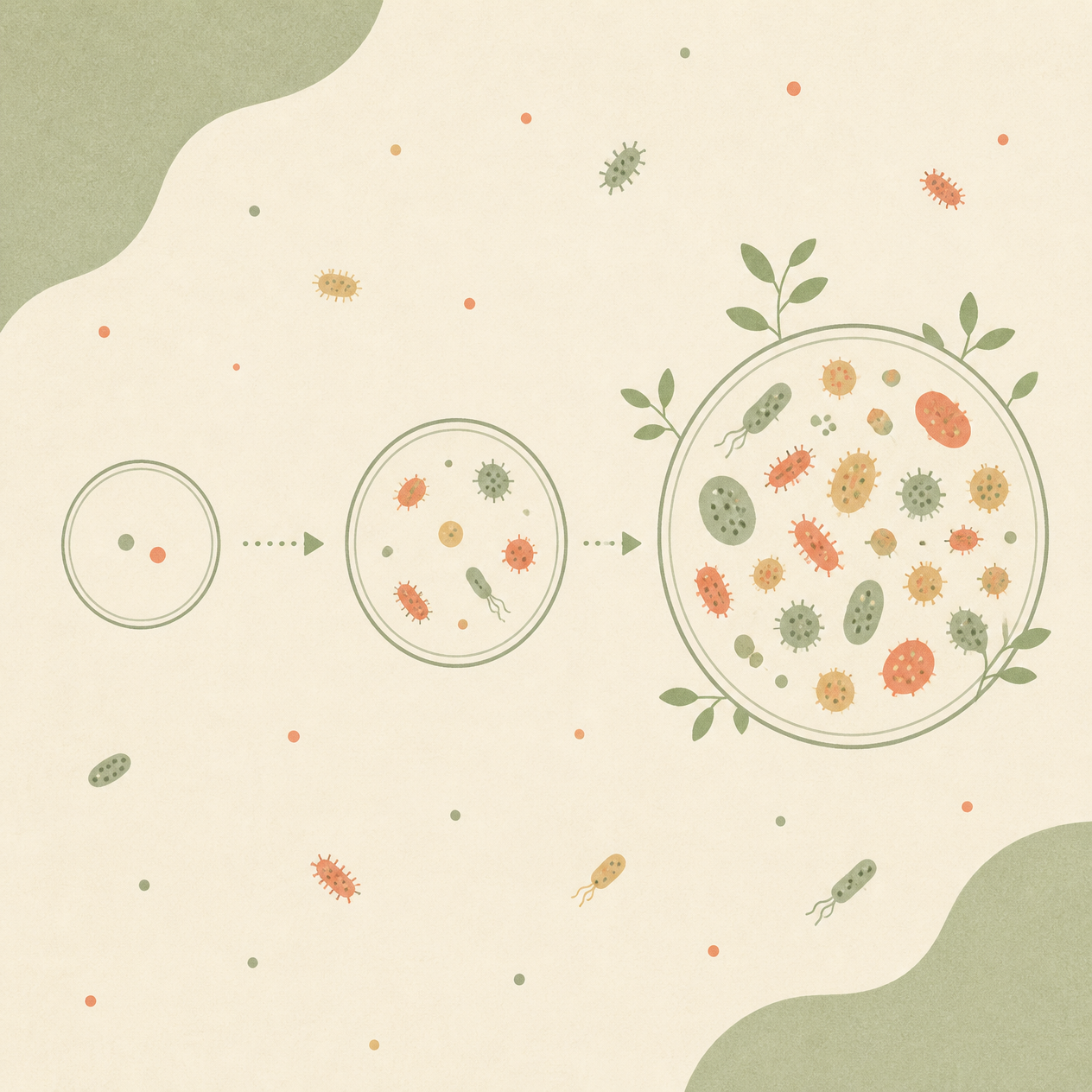
On the day you were born, your gut was almost empty of bacteria. Today it is home to around 38 trillion of them, roughly one for every human cell in your body.
That community didn't arrive all at once, and it didn't arrive by accident. It was seeded, fed, shaped and tested over years, and it is still changing with every meal you eat. Understanding how it grew is the key to understanding why it is worth looking after, and why the work is never quite finished.
A few facts to start
Your gut bacteria weigh around 200 grams, about the same as an apple, and most live in your large intestine.
Together they carry more than 100 times as many genes as your own genome.
Each person hosts hundreds of species, in a mix as individual as a fingerprint.
They make vitamins, train your immune system and produce compounds that reach your brain.
Chapter 1: A sterile start and the great handover
A healthy baby in the womb has essentially no gut microbes. The first real colonisation happens during birth, and how a baby is born shapes who moves in first.
Vaginal birth: the baby swallows microbes from the mother's birth canal and gut on the way out, including Lactobacillus and Bacteroides. It is one of the first gifts a mother passes on, and she doesn't even know she's giving it.
Caesarean birth: the first arrivals come mostly from skin and the surrounding environment instead.
These early differences largely even out over the first year, and plenty of caesarean-born children grow up with thriving microbiomes. But it is a striking reminder that our microbes are inherited, passed from person to person and generation to generation.
Learning point: your microbiome began as a handover from your mother, and it has been shaped by the people, places and foods around you ever since.
Chapter 2: Breast milk, a meal for microbes
Here is one of nature's cleverest tricks. Breast milk is packed with sugars called human milk oligosaccharides, and babies can't digest them at all. They are there to feed bacteria, especially Bifidobacterium infantis, a species that thrives on them and helps crowd out less friendly microbes.
In other words, breast milk doesn't just feed the baby. It feeds the baby's microbes, deliberately choosing which ones flourish. Breast milk also carries some bacteria of its own.
From there, every new experience adds to the mix: skin contact, siblings, pets, crawling on the floor and, especially, starting solid food. Each new food brings new fibres, and new fibres feed new species.
By around age two to three, a child's gut community starts to resemble an adult's. This is why the first 1,000 days of life get so much attention. It is the window when the microbiome is most open to change, and when it is busy teaching the developing immune system what to tolerate and what to fight.
Learning point: the earliest microbes aren't random. Food, from the very first feed, decides which ones thrive.
Chapter 3: Why most microbes you swallow never move in
As adults, we swallow millions of microbes every day, from food, water, the people we kiss, the dogs we pat and the garden soil under our nails. So why doesn't our gut change with every mouthful?
Because the gut is well defended, in three layers:
Stomach acid kills most microbes on arrival.
Bile in the small intestine finishes off many of the survivors.
The residents are the toughest barrier of all. An established community occupies the best spots along the gut lining and uses up the available food, leaving little room for newcomers. Scientists call this colonisation resistance.
This is mostly good news, because it protects you from many harmful bugs. But it also explains why most probiotic bacteria pass through as temporary visitors rather than settling in for good. They can still have useful effects on the way through, but they rarely become permanent residents.
Learning point: you can't simply swallow a new microbiome. The residents decide who stays, and what they eat decides how strong they are.
Chapter 4: You are what your microbes eat
If swallowing microbes isn't the main way the gut changes, what is? The answer is food, and in particular the parts of food you can't digest yourself.
Fibre and resistant starch pass through the small intestine untouched and arrive in the colon, where your microbes are waiting. They ferment it, and in doing so produce short-chain fatty acids such as butyrate, acetate and propionate. Butyrate is a star: it is the main fuel for the cells lining your colon, it strengthens the gut barrier, and it calms inflammation.
Different microbes prefer different fibres. Some love the inulin in onions, garlic and leeks. Others prefer the beta-glucans in oats, the pectin in apples, or the resistant starch in cooled potatoes and green bananas. Feed a group well and it expands. Stop feeding it and it shrinks, sometimes until it is hard to detect at all.
This is why variety matters so much. A narrow diet feeds a narrow range of microbes. A diverse diet supports a diverse community, and diversity is one of the strongest markers of a healthy gut.
Learning point: every meal is a decision about which microbes you are feeding.
Why it matters: what a thriving microbiome does for you
Your gut microbes are not passengers. They work for you around the clock, and their reach goes far beyond digestion.
Immunity: a large share of your immune cells sit in and around the gut. Your microbes constantly train them, teaching the difference between a real threat and a harmless food or pollen.
Inflammation: butyrate and other short-chain fatty acids keep the gut barrier tight and dampen inflammation, both locally and throughout the body.
Metabolism and weight: gut microbes influence how much energy you extract from food, how you handle blood sugar, and the release of appetite hormones such as GLP-1 that tell you when you're full.
Mood and the brain: around 90% of your body's serotonin is made in the gut, and gut microbes influence how much is produced. They also talk to the brain via the vagus nerve, part of what is known as the gut-brain axis.
Nutrients: some gut bacteria make vitamin K and several B vitamins, and they help release minerals and plant compounds from food.
Protection: a strong, diverse community leaves little room for harmful bugs to take hold.
When this community is depleted or out of balance, the effects can show up well beyond the gut: in energy, skin, mood, weight, immunity and food reactions.
Why your microbiome needs to keep growing
It is tempting to think of the microbiome as something set in childhood. In reality, it is less like a statue and more like a garden. It responds to how it is tended, and it can thin out quietly over time.
It changes with what you eat, season by season. The Hadza people of Tanzania, who still hunt and gather, have gut microbes that shift with the wet and dry seasons as their diet changes. Some species fade when their favourite foods disappear, then return when those foods come back. Their microbiomes are also far more diverse than those of people in industrialised countries.
Modern life tends to shrink it. Low-fibre, highly processed diets, repeated courses of antibiotics, chronic stress, poor sleep and a lack of time outdoors all reduce diversity. Most Australians don't reach even the recommended minimum intake of fibre, which means many gut microbes are simply going hungry.
Losses can carry across generations. In one striking Stanford study, mice fed a low-fibre diet lost microbial species. In a single generation, returning fibre to the diet brought most of them back. But when the low-fibre diet continued over four generations, the losses compounded, and adding fibre back was no longer enough to restore what had disappeared. The missing microbes had to be reintroduced.
The message is hopeful as well as sobering. Your microbiome is constantly responding to what you give it, which means you can shift it in a better direction at any age.
Learning point: a diverse microbiome isn't something you have, it's something you keep growing.
How to keep growing yours
The good news is that the steps are simple, and most of them happen on your plate. The focus is on adding foods rather than cutting them out, the same principle behind the G.E.M.M. Protocol.
Aim for 30 different plants a week. The American Gut Project, one of the largest citizen science studies of the microbiome, found that people who ate 30 or more types of plants each week had more diverse gut microbes than those who ate 10 or fewer. Vegetables, fruit, legumes, wholegrains, nuts, seeds, herbs and spices all count. Keep a tally on the fridge and make it a game.
Vary your fibres. Rotate legumes, oats and barley, onions, garlic and leeks, apples and pears, and cooked-then-cooled potatoes or rice for resistant starch. Different fibres feed different microbes.
Add fermented foods daily. In a 2021 Stanford study, people who ate about six serves of fermented foods a day for 10 weeks increased their microbial diversity and lowered markers of inflammation. Think plain yoghurt, kefir, sauerkraut, kimchi and kombucha.
Eat colour. Polyphenols in berries, cocoa, green tea, extra virgin olive oil and herbs act as food for beneficial microbes too.
Go low and slow. If your gut is sensitive, a sudden jump in fibre can cause bloating. Build up gradually. If certain foods consistently cause symptoms, something like SIBO or histamine intolerance may be worth investigating first, especially if it feels like you are reacting to everything.
Use antibiotics wisely. Take them when you truly need them, and give your gut extra support afterwards. Read more in Rebuilding Your Gut After Antibiotics.
Live a little more like your ancestors. Time outdoors, gardening, pets, movement and good sleep all support a healthier, more diverse microbiome.
Curious what's living in your gut?
General advice is a great start, but every microbiome is different. Microba testing uses a simple stool sample to map the species in your gut, how diverse your community is, and what it is capable of producing, including butyrate and other key compounds.
With those results, I can build a nutrition plan around the microbes you actually have, feeding the ones that are missing and rebalancing the ones that have taken over. Find out more in Gut Microbiome Testing: What It Can (and Can't) Tell You, or book a consultation in person or by telehealth.
Your microbiome has been growing since the day you were born. There has never been a better time to feed it well.
This article is general information and is not a substitute for individual medical advice.
References
Sender R, Fuchs S, Milo R. Revised estimates for the number of human and bacteria cells in the body. PLoS Biology, 2016.
McDonald D et al. American Gut: an open platform for citizen science microbiome research. mSystems, 2018.
Wastyk HC et al. Gut-microbiota-targeted diets modulate human immune status. Cell, 2021.
Sonnenburg ED et al. Diet-induced extinctions in the gut microbiota compound over generations. Nature, 2016.
Smits SA et al. Seasonal cycling in the gut microbiome of the Hadza hunter-gatherers of Tanzania. Science, 2017.
Yano JM et al. Indigenous bacteria from the gut microbiota regulate host serotonin biosynthesis. Cell, 2015.